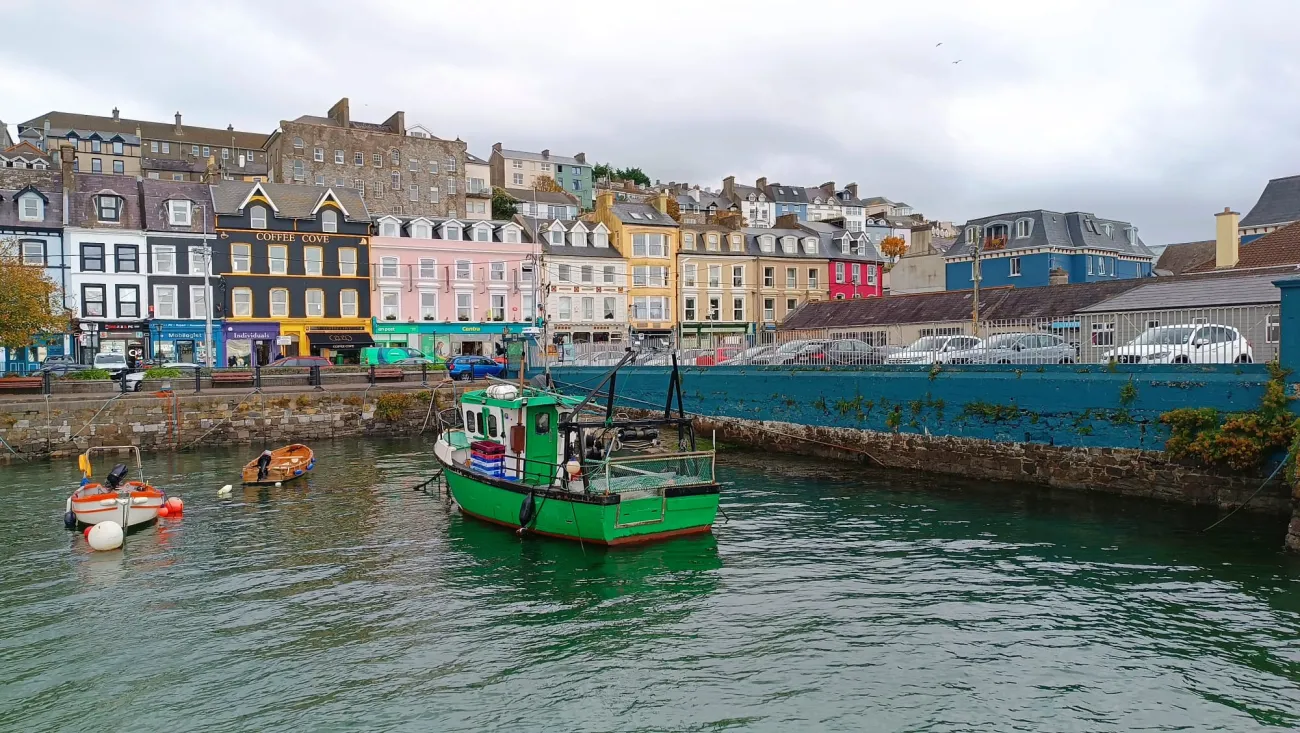
Between 15 and 17 October 2025, Drs. Chiara Certomà (Sapienza University of Rome – MEMOTEF) and Mr. Federico Fornaro (Raw-News Visual Production Agency) carried out a field research mission in Cork Harbour (Ireland), including a visit to the port of Cork and the harbour town of Cobh. This activity was conducted under the framework of PartArt4OW and the ongoing research agenda of CO>SEA.
🌊 Why This Research Matters
Harbour areas like Cork Harbour historically mediate the connection between land and sea. They have long acted as vital interfaces — shaping cultural, economic and social relations between human communities and the ocean. But across many European harbours, recent decades have brought processes of touristification, privatisation, gentrification and environmental degradation — trends that risk eroding traditional maritime communities, their heritage, and marine ecologies.
The field research aimed to investigate whether harbours — often overlooked in both marine science and urban politics — can be reimagined as spaces of sustainable social-environmental engagement, cultural memory, community participation and ecological resilience. In doing so, PartArt4OW seeks to extend its mission: combining art, science and civic involvement to strengthen emotional, social and ecological ties with ocean and water basins across Europe.
📍 What Happened: The Cork Harbour Mission
Over three days in mid-October, Drs. Certomà and Mr. Fornaro engaged with local researchers, stakeholders and citizens in Cork and Cobh. The methodology adopted was that of marine social and visual geography — combining interviews, participatory observations, spatial analysis and photographic documentation.
Among the topics explored there were:
- the social and environmental pressures faced by harbour communities (pollution, industrial activity, cruise-ship traffic, inequalities, housing pressures), especially in areas designated as Special Protection Areas (SPAs), such as Cobh.
- the impact of port and harbour transformations — privatisation, decline of traditional maritime industries such as small-scale fishing or ship-related labour — on local identities, livelihoods and access to the sea.
- the potential for harbour neighbourhoods to become hubs of community-led cultural life, sustainable economies, and inclusive urban-sea relation — blending heritage, ecology, and collective creativity.
The research collected initial data and narratives; it also mapped critical issues and opportunities for re-imagining harbour spaces as gateways for ocean citizenship, inclusive urban-sea relations, and sustainable coastal futures.
🎯 Relevance for PartArt4OW’s Vision
This mission is emblematic of PartArt4OW’s core philosophy: that oceans and waters are not only ecological systems to be preserved—but living socio-cultural spaces where communities, memories, livelihoods and creativity converge.
By focusing on harbours like Cork, PartArt4OW helps to broaden the traditional notion of “marine space”: rather than limiting it to open seas or remote ecosystems, it embraces coastlines, ports, harbour towns, waterfront communities — places where human and marine worlds have always met.
Such research can feed into:
- Participatory Art Initiatives (PAIs) that engage harbour communities in creative expression and reclaiming their maritime heritage;
- Policy and planning proposals for sustainable harbour regeneration, combining environmental protection, social justice, heritage preservation and inclusive cultural programming;
- Increased marine and water literacy, promoting deeper public awareness of how harbours mediate ocean-land relations;
- Transnational exchange: findings from Cork can resonate with similar harbour contexts across Europe under PartArt4OW’s network.
🔭 What Comes Next
The insights gathered during the Cork Harbour mission will inform future PartArt4OW activities, including the design of PAIs centred on harbour spaces, community-led mapping of socio-environmental issues, and visual or participatory projects aimed at re-imagining urban-sea relationships.
Moreover, this exploratory research sets the groundwork for comparative studies: by juxtaposing coastal harbours across Europe, PartArt4OW aims to contribute to a shared framework of marine social geography, ocean citizenship, and community-driven water governance.
We invite researchers, artists, citizens and local stakeholders — especially those connected to harbour or coastal communities — to follow the evolution of this line of inquiry, to join the conversation, and to contribute to building more inclusive, sustainable and culturally rich futures for our harbours and seas.